How to Run a CEO Town Hall People Will Actually Watch
A CEO town hall works when employees leave with fewer rumours, clearer priorities, and the sense that leadership is willing to answer the real question. It loses people when it turns into a long video meeting with weak sound, vague language, and a Q&A nobody trusts.
On This Page
Publication Date
Reading time
This guide is for communication leads, HR teams, and senior leaders planning a high-stakes internal update. It covers when a town hall is the right format, how to structure it, how to brief the CEO, and how to make the replay useful instead of dumping a raw recording into the intranet and hoping for the best.
Start with the job the town hall needs to do
A CEO town hall is a communication tool for moments when the organisation needs shared clarity. It can explain a strategic shift, translate business performance into employee reality, show leadership presence during change, or answer questions that are already moving through the company.
That matters because employees are often less informed than leadership thinks. In the 2025 International Employee Communication Impact Study by Staffbase and YouGov, internal communication quality ranked poorly, and change communication remained a weak spot across several markets, including Switzerland. Separate research in Public Relations Review found that transparent internal communication supports organisational trust and openness to change. If the message is vague, the format will not rescue it.
Before you build slides, write one sentence that answers this question: what should employees understand, feel, or do differently after this session? If that sentence is weak, the town hall will be weak.
Decide whether a town hall is actually the right format
A town hall is strong when many people need the same message at the same time, when visible leadership matters, and when moderated questions can reduce confusion. Strategy updates, cultural topics, business performance updates, and carefully prepared change communication often fit well.
It is the wrong choice when the issue is too raw, too incomplete, or too sensitive for a one-to-many format. Fast-moving crisis communication is the clearest example. If the company has never run a proper town hall before, building one from scratch in the middle of a crisis is usually a bad idea. It takes too long, it can look too polished, and it creates distance when people need something more direct.
Use a town hall when the main need is shared clarity. Skip it when the main need is immediate reassurance, confidential discussion, or line-manager conversation inside smaller groups.
Make five decisions before you start
Most weak town halls are not ruined by one dramatic mistake. They drift because five basics were never properly settled.
Audience
Be specific. Is this for the whole company, one region, one business unit, or one leadership layer? Large companies often overestimate how much background knowledge employees share. If finance, operations, sales, and frontline teams all join the same session, the language has to reflect that.
Goal
Pick one primary goal. Inform. Align. Reassure. Mobilise. If everything is equally important, nothing sticks.
Format
Choose the production model deliberately: stage event with livestream, studio-style broadcast, executive interview, or panel conversation. A single leader staring into a laptop camera is rarely the right answer for a company-wide update.
Language
For international companies, language cannot be an afterthought. It shapes pace, comprehension, and trust. Automatic live captions are usually the wrong answer in internal town halls. They often fail on internal terms, acronyms, and non-native speech. A better model is to let employees who follow the spoken language watch live, then publish a reviewed subtitled replay shortly afterwards. If part of the workforce needs more support in the moment, manager-led group viewing can work better than unreliable live captions.
Q&A model
Decide this early. No Q&A, a staged Q&A where leaders answer pre-selected questions presented as audience questions, open microphones, curated live questions, and anonymous moderated questions all create different levels of trust and risk. For most company-wide town halls, the best practical option is live question collection with visible moderation, then a host reads the strongest questions aloud. That feels real without turning chaotic.
Build an agenda that can hold attention
A town hall can run for 45 minutes and still hold attention. What loses people is not the number on the clock. It is a slow start, shapeless speaking, and no clear sense of why the message matters.
Keep the structure tight. Put the CEO early. Show employees why the topic matters to them before you move into detail. Then end with a closing message that gives people direction and some lift. Facts matter. So does tone.
- 0 to 5 minutes: host framing, why this session matters, how questions will work
- 5 to 15 minutes: CEO message, plain-language context, what changed and why
- 15 to 25 minutes: business or leadership update with one supporting voice if needed
- 25 to 40 minutes: moderated Q&A
- 40 to 45 minutes: closing from the CEO, what matters now, what happens next, where unanswered questions will be addressed
If the topic needs more depth, add that depth in follow-up material, not in a live monologue that keeps expanding because nobody wants to cut anything.
Brief the CEO and speakers properly
The most common speaker problem is not nerves. It is over-explaining. Leaders talk too long, use internal shorthand, and assume the audience knows far more than it does. Once the language slips into business lingo, people check out.
A good brief forces focus. For each speaker, define the one message that must land, the one consequence employees care about, and the one difficult question most likely to come up. Then cut whatever does not help.
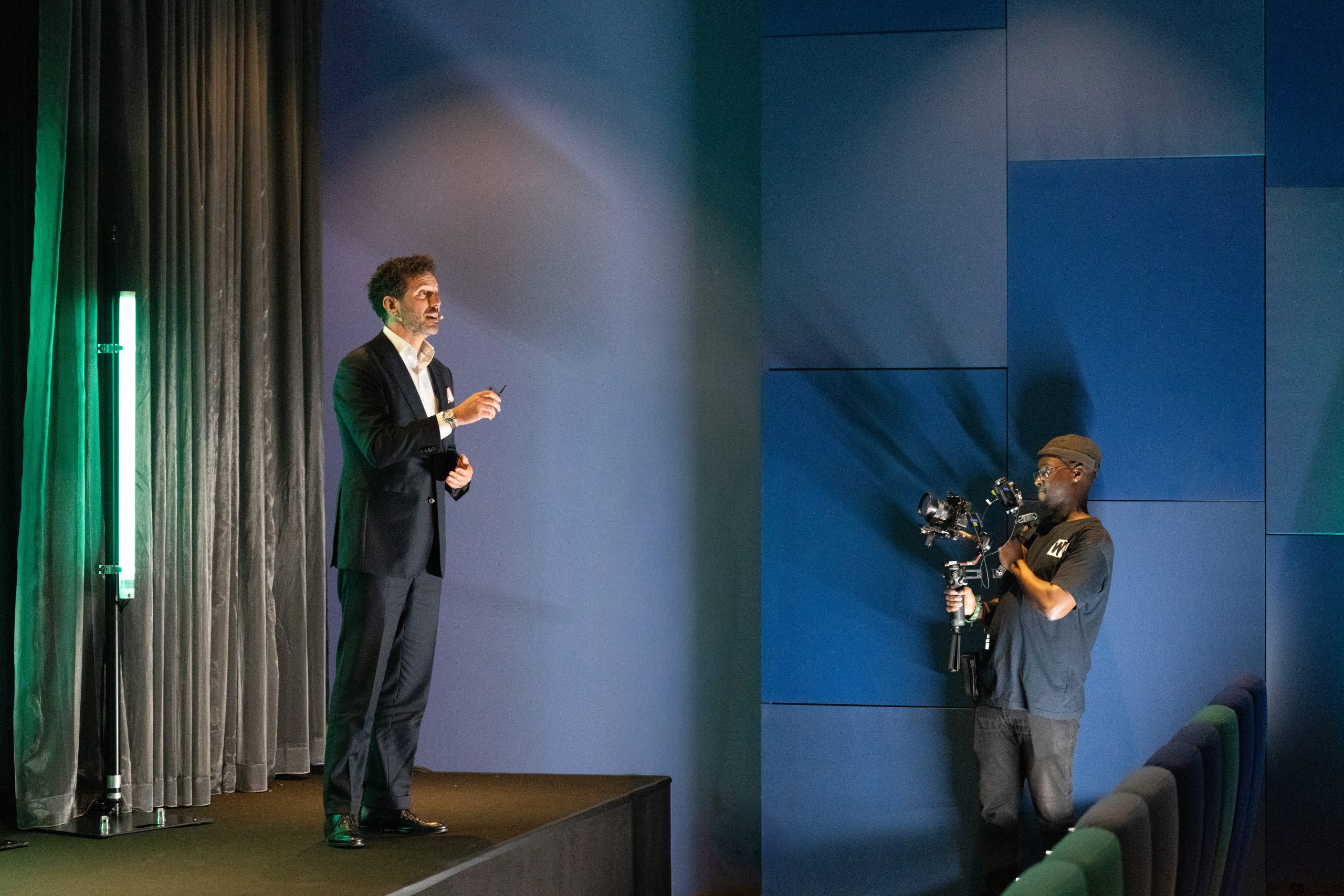
If the CEO is uncomfortable on camera, do not isolate them in a small meeting room with a laptop. A larger stage setup with a real in-room audience often works better. Senior leaders usually speak more naturally to people than to a lens and a deck.
Rehearsal should be short and specific. Check the opening, the transitions, the pace, and the likely difficult questions. Then stop.
Design a Q&A that people can trust
Q&A is where trust is built or damaged. Employees know when the process is cosmetic. If the CEO reads a few suspiciously tidy questions from a card, people assume the difficult ones were filtered out.
That does not mean open microphones for everyone. In large company-wide events, open microphones usually create noise, delay, and unnecessary exposure. Moderated written questions are a better default.
The middle ground is straightforward:
- collect questions before the event so you understand the pressure points
- keep live submission open during the event
- moderate for relevance, duplication, privacy, and legal risk
- have a host read questions in plain language
- answer some hard questions directly, even when the answer is incomplete
- publish follow-up answers afterwards for what you could not cover live
Anonymous questions can help when the topic is sensitive. They should not become an excuse for vague answers. Moderation should protect usefulness and confidentiality, not leadership from reality.
Plan the live, hybrid, and replay experience on purpose
The live moment matters because it creates a shared point of reference. Hybrid matters when you want some visible energy in the room. Replay matters because many organisations work across time zones, shifts, and travel schedules.
Do not treat the replay as an afterthought. Regional managers, late joiners, and shift-based teams often consume the message there, not live.
Accessibility sits here as well. W3C guidance on captions treats them as a core part of usable video. For internal town halls, that usually means reviewed subtitles on the recording rather than automatic live captions. Accuracy matters, especially when company language, names, and acronyms are involved.
If some employees cannot comfortably follow the live language, give them a workable path. That can mean a manager-led group viewing, a short local recap afterwards, or a reviewed subtitled replay published within a day or two.
Decide these points before the event:
- Will the full recording be shared, or an edited replay?
- Will reviewed subtitles and a transcript be available afterwards?
- Will managers receive a short cascade brief for local team discussions?
- Will unanswered questions be answered in writing?
- Which metrics will count as success: live attendance, watch time, replay use, question volume, follow-up action, or manager feedback?
Remove the common failure points before they happen
Most town hall failures are predictable.
- Weak technology: poor sound, unstable connection, unreadable slides, one static laptop shot
- Too much talking: long answers, no editing, no respect for employee time
- Too much business language: terms that make sense in the executive team and nowhere else
- Staged responsiveness: a Q&A that looks open while avoiding the real issue
- No follow-up: no replay, no summary, no answers to the questions people still have
- Wrong event logic: using a town hall for a situation that needs smaller, closer communication
The technical point deserves emphasis. Employees forgive simple visuals. They do not forgive bad sound. If the event matters enough to involve the CEO, it matters enough for rehearsal, a proper microphone, and clear production roles.
Use this simple CEO town hall checklist
- Define the single communication outcome.
- Confirm that a town hall is the right format.
- Lock audience, goal, format, language, and Q&A model.
- Write a short run of show with time limits.
- Brief the CEO in plain language, not slide order.
- Prepare answers to the three hardest likely questions.
- Test audio, slides, lighting, internet, and backup paths.
- Assign roles for host, producer, Q&A moderation, and speaker support.
- Tell employees why the event matters and how questions will work.
- Decide what will be shared afterwards.
- Plan reviewed subtitles, transcript, and manager follow-up where needed.
- Review success metrics before the event starts.
Know when to bring in an external production partner
Some town halls can be run well with an internal communications team and a disciplined setup. Others need outside support. The threshold is usually risk.
External production and moderation support makes sense when the event is multilingual, politically sensitive, technically complex, high-visibility, or tied to a major strategic shift. It also helps when the CEO needs support to sound clear and credible under pressure, or when the communications team needs to focus on stakeholders instead of production mechanics.
The right partner should make the event calmer, clearer, and more human. More gloss is not the point.
Good to know
How long should a CEO town hall be?
Usually 30 to 45 minutes. Longer can work if the topic justifies it and the pace is good, but most town halls get weaker when too much detail is forced into the live session.
Should employees be able to ask questions anonymously?
Often yes, especially during change communication or emotional topics. Anonymous submission surfaces questions people might otherwise keep to themselves. It still needs moderation and direct answers.
Is an open microphone Q&A a good idea?
Usually not for a company-wide event. Open microphones slow the session, create avoidable risk, and favour the people most comfortable speaking live. Moderated written questions are usually better.
Do CEO town halls need captions?
For the replay, yes. For the live session, usually not as an automatic layer. In internal town halls, automatic captions often fail on internal terms, acronyms, and non-native speech. Reviewed subtitles on the recording are usually the better standard.
What should we measure after the event?
Look beyond attendance. The more useful signals are live watch time, replay views, drop-off points, question quality, unanswered themes, and whether managers still have to re-explain the core message afterwards.