Virtual video studios can make corporate marketing faster, more flexible, and easier to repeat at a high standard. The real question is not whether virtual production is useful. It is which setup gives you enough realism and control without making the production heavier or more expensive than the brief requires.
For some teams, a simple green screen is enough. Others benefit from a large display in the background. The most advanced option, LED walls with camera tracking, creates the strongest illusion of depth and movement, but only makes sense when the production value and frequency justify it.
Table of Contents
What virtual video studios change in corporate marketing
A virtual video studio combines a real presenter with a digitally controlled environment. In corporate marketing, that matters because it reduces dependence on physical locations and makes recurring production easier to standardise. The same room can become a set for a leadership update, a product explainer, a customer story, or an event opener without rebuilding everything from scratch each time.
What separates the main setup levels is where the realism comes from and where the work happens. A green screen keeps the room simple and shifts more of the visual work into post-production. A large display makes the background visible during filming and gives contributors something real to respond to. LED walls with tracking create the most convincing result because perspective, reflections, and camera movement behave more naturally in camera.
That distinction matters for decision-makers. The question is rarely which technology sounds most advanced. The better question is which setup helps your team produce the right kind of content reliably.
Level 1: Simple green screen studios
Green screen remains the most accessible entry point. It is a sensible choice for straightforward formats such as executive messages, training clips, internal updates, short campaign assets, and other controlled talking-head videos. The setup cost is manageable, the footprint is relatively small, and backgrounds can be changed later without rebuilding a physical set.
The trade-off is discipline. Chroma key footage only works well when lighting is even, the subject is separated cleanly from the background, and wardrobe, edges, and shadows are handled carefully. If those details are ignored, the final composite looks cheap very quickly. That is why green screen is practical, but not automatic.
For many companies, the real advantage is efficiency. A lean team can run this kind of setup well, and the studio can support a high volume of repeat content. If the brief does not depend on camera movement or subtle spatial realism, green screen is often enough. It rewards preparation more than budget.
Level 2: Large display as background
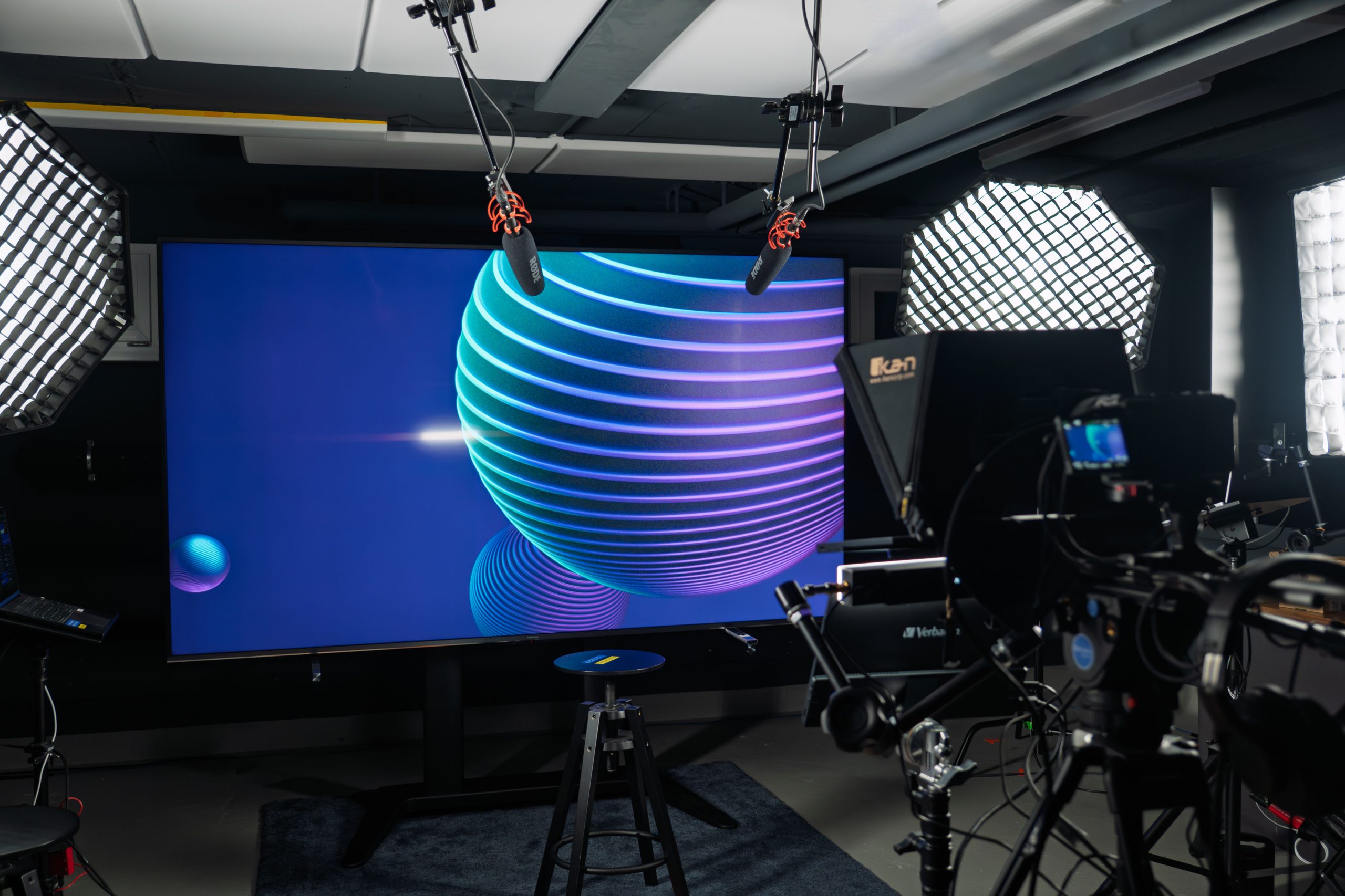
A large display behind the presenter is the middle ground between green screen and a full virtual stage. It gives the speaker a visible environment on set and usually produces a more natural result in camera. For interviews, explainers, moderated discussions, and branded studio formats, that can be a meaningful improvement because the presenter is reacting to something real rather than imagining the final background.
This setup works best when the camera stays mostly static or moves only slightly. Once the shot becomes more dynamic, the illusion weakens because the background does not change perspective like a tracked virtual environment would. Still, that limitation is acceptable for a great deal of corporate content, where the camera language is intentionally restrained.
Operationally, this level is attractive because it reduces the amount of specialist post-production work compared with green screen while staying much lighter than an LED volume. It is often the right choice for teams that want more realism on set without stepping into the cost, space, and crew demands of a premium installation.
Level 3: Full virtual sets with LED walls and motion tracking
LED walls with motion tracking are the premium option because they address the realism problem at the source. The virtual background shifts with the camera, which preserves perspective and creates parallax. The wall also casts interactive light and reflections onto the presenter and objects on set. That is what makes the result feel more spatially believable than a flat background replacement.
This level makes sense when the content has real strategic visibility: flagship campaigns, high-end product launches, investor-facing communication, broadcast-style formats, or studio concepts that will be reused often enough to justify the setup. When camera movement, realism, and repeatability matter together, LED production becomes more compelling.
The downside is clear. These environments are expensive, technically demanding, and space-hungry. They also require a proper crew and more coordination on shoot days. For most organisations, this is not the first step to take. It becomes the right step when the brief genuinely depends on what the technology does better, rather than on the appeal of using the most advanced option.
How to choose the right setup
Start with the format, not the hardware. If you need frequent, simple videos and can manage careful lighting and clean post-production, green screen is often the right answer. If you want a more natural set for mostly static formats, a large display may give you the best balance. If the brief demands camera movement, premium realism, and repeated use across high-value productions, LED walls with tracking are worth considering.
In practice, the best studio is the one that supports the message without making the workflow unnecessarily heavy. Corporate marketing does not benefit from technical theatre for its own sake. It benefits from a production environment that makes good communication easier to deliver again and again.
FAQ
What is a virtual video studio?
A virtual video studio combines a real presenter with a digitally controlled background or set. Depending on the setup, that background is added in post-production, shown on a display during filming, or rendered live on LED walls with camera tracking.
Is green screen good enough for corporate marketing?
Often, yes. Green screen is a practical choice for explainers, leadership updates, training content, and other controlled formats. It becomes less attractive when the production needs more natural interaction on set or more demanding camera movement.
When is a large display better than green screen?
A large display is better when you want the presenter to see the background during filming and you want a more natural in-camera result. It is especially useful for static or near-static formats where reduced post-production work matters.
Why do LED walls need motion tracking?
Motion tracking allows the virtual background to shift correctly as the camera moves. That preserves perspective, creates parallax, and helps the final image feel spatially believable rather than flat.
Which setup is best for executive communication videos?
For most executive communication, the best setup is the simplest one that keeps the message clear and the production reliable. That usually means green screen or a large display background. LED walls make sense when the format has a strategic reason to feel more cinematic or immersive and the production can support a larger setup.